Guides • Perfecting your Craft
Last updated on Oct 15, 2025
6 Unbreakable Dialogue Punctuation Rules All Writers Must Know

Martin Cavannagh
Head of Content at Reedsy, Martin has spent over eight years helping writers turn their ambitions into reality. As a voice in the indie publishing space, he has written for a number of outlets and spoken at conferences, including the 2024 Writers Summit at the London Book Fair.
View profile →Dialogue punctuation is a critical part of written speech that allows readers to understand when characters start and stop speaking. By following the proper punctuation rules — for example, that punctuation marks almost always fall within the quotation marks — a writer can ensure that their characters’ voices flow off the page with minimal distraction.
This post’ll show you how to format your dialogue to publishing standards.
6 essential dialogue punctuation rules:
- 1. Always put commas and periods inside the quote
- 2. Use double quote marks for dialogue (if you’re in America)
- 3. Start a new paragraph every time the speaker changes
- 4. Use dashes and ellipses to cut sentences off
- 5. Deploy single quote marks used for quotes within dialogue
- 6. Don’t use end quotes between paragraphs of speech
1. Always put commas and periods inside the quote
The misplacement of periods and commas is the most common mistake writers make when punctuating dialogue. But it’s pretty simple, once you get the hang of it. You should always have the period inside the quote when completing a spoken sentence.
Example: “It’s time to pay the piper.”
As you’ll know, the most common way to indicate speech is to write dialogue in quotation marks and attribute it to a speaker with dialogue tags, such as he said, she said, or Margaret replied, or chirped Hiroko. This is what we call “attribution” when you're punctuating dialogue.
Q: What common dialogue pitfalls do you often encounter in fiction, and how can writers avoid them?
Suggested answer


I wouldn't say I get frustrated as much as these are things I try to fix or encourage authors to think about.
Not considering how people speak in real life. In real conversation, people use contractions, incomplete sentences, half-baked thoughts, casual grammar. Read your dialog aloud. Does it feel natural to say or is it stiff? Sometimes using a contraction, letting a sentences trail off, or cutting an overexplaining word or two can make a difference. Also, is the vocabulary the character is using appropriate for who they are? A fifteen-year-old girl and her mother will use different words .
Working too hard to avoid said. The word "said" tends to fade into the background in well-crafted dialog, but some writers turn themselves inside out to avoid it with awkward results. While I'm sometimes (just sometimes) okay when a character laughs something or sighs something, at least those are sounds. I draw the line when a character smiles something or nods something, Those are actions, not sounds. You say it nodding or with a smile.
Relying too heavily on dialogue to impart information/overexplaining. Unless there's a specific plot-related reason, a character should not explain or probably even mention something the characters to which they are speaking are likely to already know. You need to figure out other ways to get that information across to your reader.
Using adverbs instead of language, sentence structure, or verbs to impart the emotion behind words. Can you come up with a way to impart anger that doesn't use the word angrily? How about, "he snapped," or "he said, his mouth twisting into a sneer."
Not considering the rhythm of conversation and inserting beats. Conversation isn't always a seamless back and forth. Inserting pauses with small bits of action slows things things down, gives characters time to think, and creates a more natural rhythm. It also allows time to elapse over the course of a conversation so that the cup of coffee the character pours at the beginning of the conversation might be believably finished by the end.
Sophia is available to hire on Reedsy ⏺

I think there are two: overtagging/interruptions, and on-the-nose dialogue.
Overtagging is less about the dialogue itself and more about what's going on around the dialogue. This includes tagging every line with a verbal tag (said, shouted, whispered, asked, etc.) or action/detail, and interrupting dialogue scenes with longer passages of perspective work, action, setting descriptions, and so forth. This can disrupt the pacing and make the dialogue feel choppy, even to the point that the reader can lose track of the conversation. Allow the dialogue to do the work - don't tag every line with a said, don't keep interrupting your characters' conversations. Trust in the reader's ability to follow along, and your own to write good dialogue that drives the plot forward.
On-the-nose dialogue is harder to address as an editor, because it's about how characters speak to each other, but I do come across many writers who will write in therapy-speak or have characters who say exactly what they are thinking or feeling in that moment, without filters. This flattens out the dialogue and makes the characters sound the same, as well as just being unrealistic. I think it's always worth considering how people speak to each other and how this is often dependent on personalities, personal relationships (we won't tell strangers the same things we tell our friends, for instance), and the goals of the conversation itself (speaking to a boss about a project is very different than speaking to a friend about dinner plans). People will use different modes of speech - formal, informal, slang, dialect, etc. - depending on the circumstances. I think the best thing to remember is that characters are people, with pasts and futures, fears and desires, conflicts, differences, similarities, emotional barriers, psychological problems. Let them speak for themselves, and like themselves.
Lauren is available to hire on Reedsy ⏺

I think the biggest issue I see in dialogue is having everyone speak in the same voice/style. Having every person, or even just more than one person, speak similarly makes it feel as if the author's own voice is simply being translated into multiple people, and this is most obvious when it comes to slang or catch-phrases. For instance, there's nothing wrong with the slang/informal word 'anyways' or with a sentence in dialogue starting out with the word 'anyway', but when multiple characters are using that word regularly, or even just using it close together, it all of a sudden starts to feel like everyone is speaking with the same voice.
Now, you might argue that people who live together and know each other well may likely use some of the same phrases, and that's true. I've certainly inherited some phrases/slang from my husband after more than twenty years together! But in fiction, those similarities often come across as making it feel as if a voice is being replicated, so when a character uses any distinct phrase/aphorism/uncommon slang term, it's a good idea to make sure they're the only character in your book using that phrase/term, no matter how rarely or often they use it. The 'search' function in Word is priceless when it comes to safeguarding against issues like this.
Similarly, if you know you have a tendency in dialogue to have a character change the subject or start/end casual sentences with a phrase like 'you know' or 'anyway', try to keep that phrase/word to just that character. Again, the 'search' function is your friend when it comes to issues like this!
Note that this same issue is something you want to safeguard against if you're writing dual or multi-POV works where you're using close third or first person for multiple voices, as the same issue can make it feel like everyone is speaking/thinking with the same voice even outside of dialogue.
Jennifer is available to hire on Reedsy ⏺

Two dialogue pitfalls I usually highlight for revision are:
- Using overly formal language for everyday people in contemporary settings. Most people speak using contractions (can't, won't, you'd, it'll, etc.) – even very posh ones! And I don't think it sounds right when their speech is too stiff and proper. Of course some characters may speak like this - but then you want that to be a noticeable thing about their character!
- I always urge writers to reconsider trying to emulate accents in dialogue, and rather describe how a character speaks and mention they have a particular accent if they do (whether that be a national accent or a social-class accent). Trying to phonetically portray an accent is very difficult to do accurately and I think it can make a character seem like a caricature, which is best avoided. (It also runs the risk of offending your readers, which you also don't want to do!)
Lauren is available to hire on Reedsy ⏺

Perhaps the most frequent trap is dialogue that reads as though people aren't speaking at all—too formal and stiff, or so riddled with affected slang.
Another is when two characters spell out things they both already know for the reader's sake, which reads unreal. Dialogue tags are distracting when they're too numerous or too flowery; typically "said" is everywhere and works best.
Finally, dialogue without subtext—characters expressing themselves exactly as they feel—can flatten a scene. To avoid these traps, read your dialogue out loud for unnatural phrasing, incorporate exposition into action or narration instead of speeches, and leave half the conversation to silence, body language, or what isn't said. Deliberate, natural dialogue moves the story forward without pointing out the machinery.
John is available to hire on Reedsy ⏺
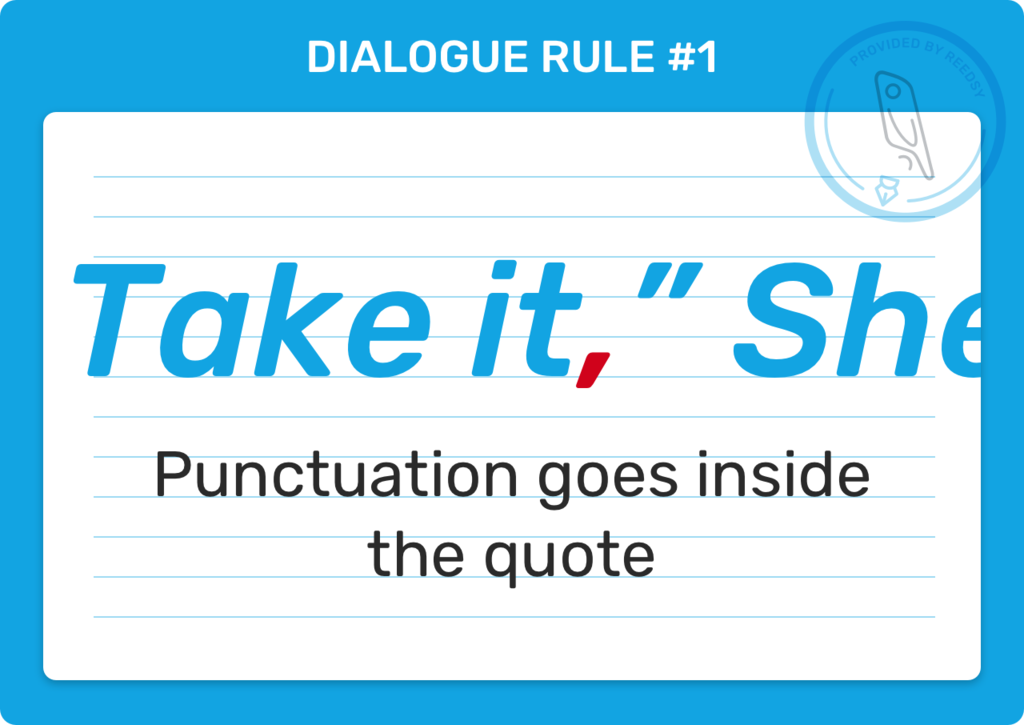
Insert a comma inside the quotation marks when the speaker is attributed after the dialogue.
Example: “Come closer so I can see you,” said the old man.
If the speaker is attributed before the dialogue, there is a comma outside the quotation marks.
Example: Aleela whimpered, “I don’t want to. I’m scared.”
If the utterance (to use a fancy linguistics term for dialogue 🤓) ends in a question mark or exclamation point, they would also be placed inside the quotation marks.
Exception: When it’s not direct dialogue.
You might see editors occasionally place a period outside the quotation marks. In those cases, the period is not used for spoken dialogue but for quoting sentence fragments, or perhaps when styling the title of a short story.
Examples:
Mark’s favorite short story was “The Gift of the Magi”.
My father forced us to go camping, insisting that it would “build character”.
Now that we’ve covered the #1 rule of dialogue punctuation, let’s dig into some of the more nuanced points.
2. Use double quote marks for dialogue (if you’re in America)
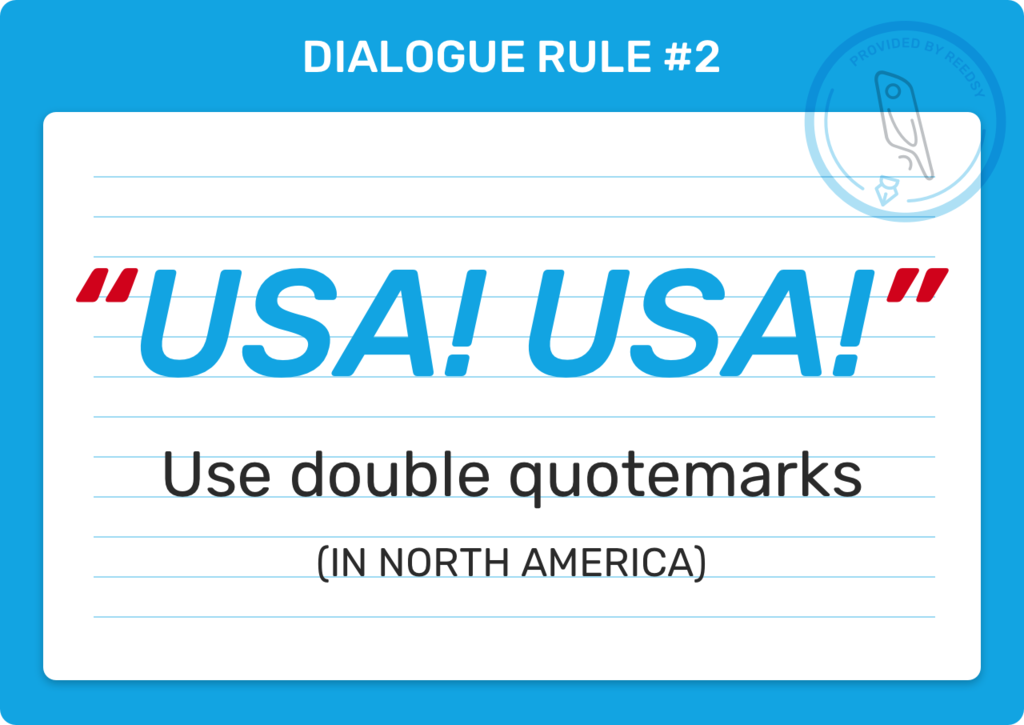
In American English, direct speech is normally represented with double quotation marks.
Example: “Hey, Billy! I’m driving to the drug store for a soda and Charleston Chew. Wanna come?” said Chad
In British and Commonwealth English, single quotation marks are the standard.
Example: ‘I say, old bean,’ the wicketkeeper said, ‘Thomas really hit us for six. Let’s pull up stumps and retire to the pavilion for tea.’
 If you’re writing for publication in the United States, refer to the widely accepted standards set by the Chicago Manual of Style. Every editor will know its rules (and many will keep a copy within arm’s reach).
Q: How much dialogue is too much dialogue?
Suggested answer
The exact answer here is going to depend on your style and the tone you're going for, but there are a couple of things to keep in mind if you're worried a scene is getting too dialogue-heavy.
1) A reader needs to be able to keep track of who's talking. If they're losing track of who's talking in a scene, especially if characters have relatively similar voices/speaking styles, that's a sign that you need to cut down on dialogue or build out the scene with more description, action, or narrative/POV.
2) If your dialogue isn't communicating much more than what a film or play script would communicate, that's a sign you're probably relying too much on dialogue. If a reader wanted to read a play or a movie script, that's what they would have picked up! Even if your characters are talking on the phone, there's still room for the character's thoughts and actions.
3) There are rare cases where it's okay for a reader to forget that a character is telling a story, but generally speaking, if dialogue is going on for so long and with so little interruption that a reader can forget it's dialogue to begin with, that might be a sign you want to re-examine how dialogue-heavy the scene is.
No matter how much dialogue you have, remember that readers are going to be more engaged if your characters speak with different voices. Distinguishing them from each other, making sure that no two are using the same rare phrasing, and paying attention to different characters' level of formality/informality will make a big difference in keeping your readers engaged, no matter how much dialogue ends up on the page.
Jennifer is available to hire on Reedsy ⏺
There is no magical number of words that constitutes "too much" dialogue—it's a matter of whether it's serving its purpose for the story or not. Dialogue works best when it's exposing character, moving plot along, or increasing tension. When the dialogue begins to go around in circles and not reveal anything new, or characters are saying what can be shown by action or description, the balance is tipped.
Too much dialogue slows a scene, yet too little renders characters flat or distant. Balance is the key: a blend of dialogue with narrative beats, interior reflection, and sensory detail keeps natural rhythm and flow. Readers should never feel as if they're listening in on filler. When every dialogue earns its place on the page, there's no such thing as "too much."
John is available to hire on Reedsy ⏺
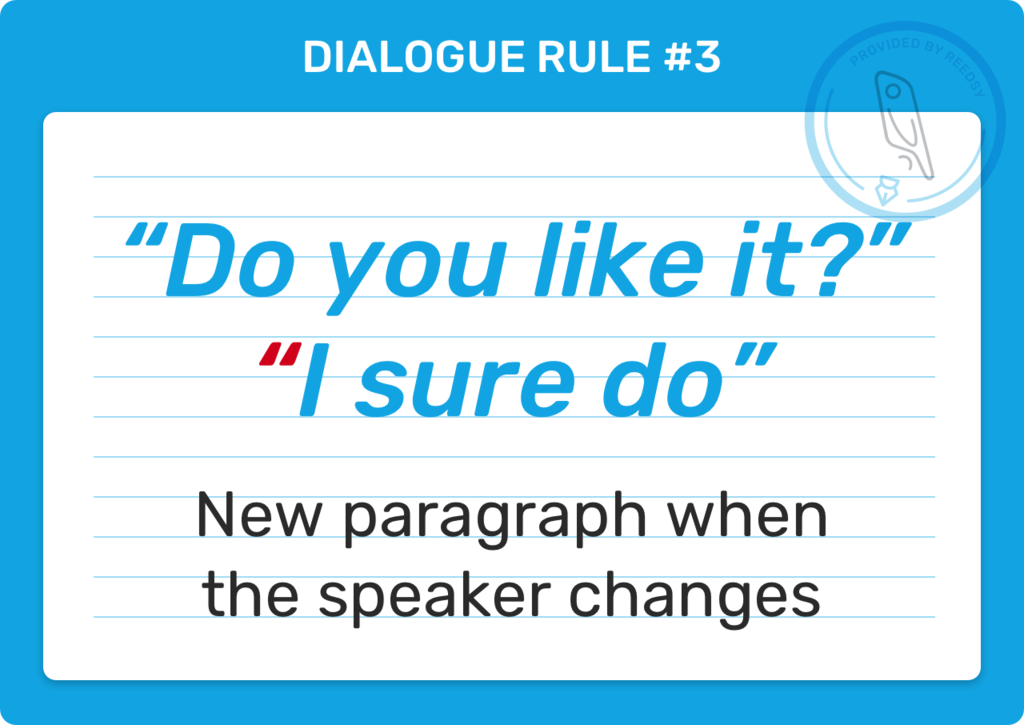
3. Start a new paragraph every time the speaker changes
This is one of the most fundamental rules of organizing dialogue. To make it easier for readers to follow what’s happening, start a new paragraph every time the speaker changes, even if you use dialogue tags.
Example:
“What do you think you’re doing?” asked the policeman.
“Oh, nothing, officer. Just looking for my hat,” I replied.
The new paragraph doesn’t always have to start with direct quotes. Whenever the focus moves from one speaker to the other, that’s when you start a new paragraph. Here’s an alternative to the example above:
“What do you think you’re doing?” asked the policeman.
I scrambled for an answer. “Oh, nothing, officer. Just looking for my hat.”
 💡Pro tip: Imagine you’re watching the conversation play out in front of you in real life. Every time you feel like you would turn your head and look at a different character, either because they’ve started to speak, or you're anticipating their reply, that’s when you would start a new paragraph.

FREE COURSE
How to Write Believable Dialogue
Master the art of dialogue in 10 five-minute lessons.
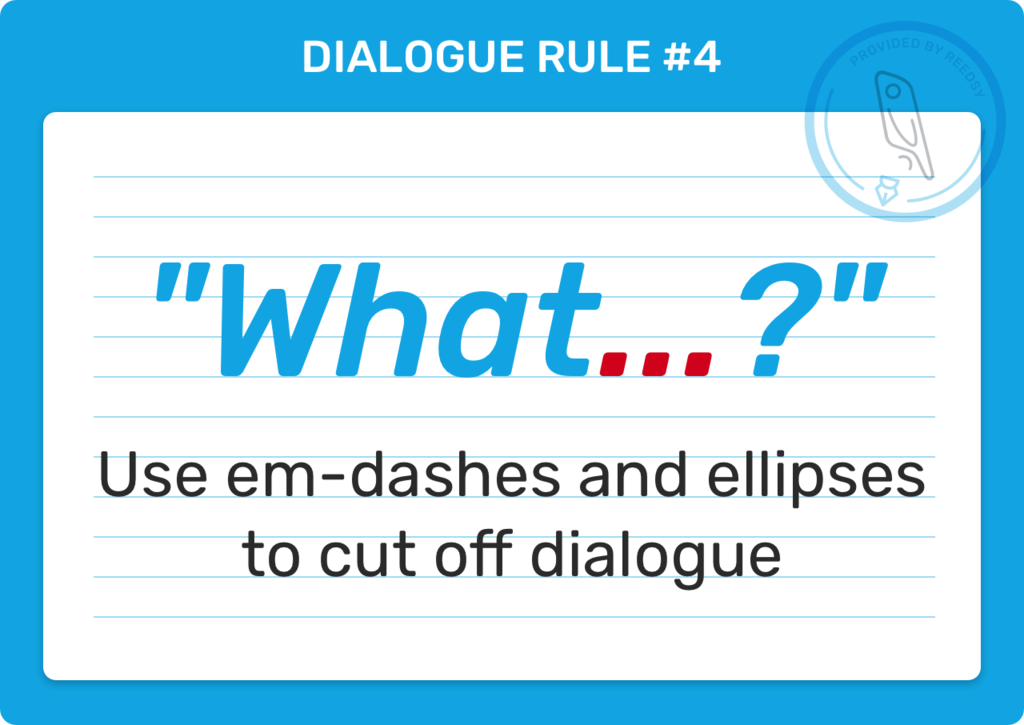
4. Use dashes and ellipses to cut sentences off
So far, all of the examples we’ve shown you are of characters speaking in full, complete sentences. But as we all know, people don’t always get to the end of their thoughts before their either trail off or are interrupted by others. Here’s how you can show that on the page.
Em-dashes to interrupt
When a speaking character is cut off, either by another person or a sudden event, use an em-dash inside the quotation marks. These are the longest dashes and can be typed by hitting alt-shift-dash on your keyboard (or option-shift-dash for Mac users).
Examples:
“Captain, we only have twenty seconds before—”
A deafening explosion ripped through the ship’s hull. It was already too late.
Or…
“Ali, please tell me what’s going—”
“There’s no use talking!” he barked.
You can also overlap dialogue to show one character speaking over another.
Example:
Mathieu put his feet up as the lecturer continued. "Current estimates indicate that a human mission will land on Mars within the next decade—"
"Fat chance."
"—with colonization efforts following soon thereafter."
Sometime people won’t finish their sentences, and it’s not because they’ve been interrupted. If this is the case, you’ll want to…
Trail off with ellipses
You can indicate the speaker trailing off with ellipses (. . .) inside the quotation marks.
Example:
Velasquez patted each of her pockets. “I swear I had my keys . . .”
Ellipses can also suggest a small pause between two people speaking.
Example:
Dawei was in shock. “I can’t believe it . . .”
“Yeah, me neither,” Lan Lan whispered.
💡Pro tip: The Chicago Manual of Style requires a space between each period of the ellipses. Most word processors will automatically detect the dot-dot-dot and re-style them for you — but if you want to be exact, manually enter the spaces in between the three periods.
5. Deploy single quote marks used for quotes within dialogue
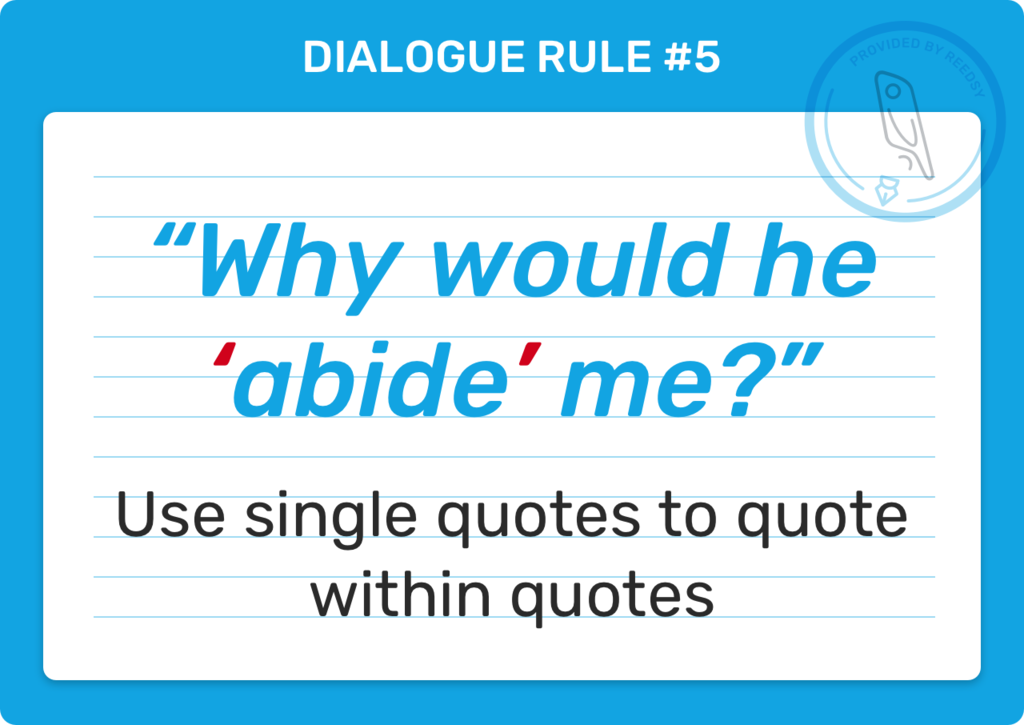
In the course of natural speech, people will often directly quote what other people have said. If this is the case, use single quotation marks within the doubles and follow the usual rules of punctuating dialogue.
Example:
“What did Randy say to you?” Beattie asked.
“He told me, ‘I got a surprise for you,’ and then he life. Strange, huh?”
But what if a character is quoting another person, who is also quoting another person? In complex cases like this (which thankfully aren’t that common), you will alternate double quotation marks with single quotes.
Example:
“I asked Gennadi if he thinks I’m getting the promotion and he said, ‘The boss pulled me aside and asked, “Is Sergei going planning to stay on next year?”’”
The punctuation at the end is a double quote mark, followed by a single quote mark, followed by another double quote. It closes off:
- What the boss said,
- What Gennadi said, and
- What Sergei, the speaker, said.
Quoting quotes within quotes can get messy, so consider focusing on indirect speech. Simply relate the gist of what someone said:
“I pressed Gennadi on my promotion. He said the boss pulled him aside and asked him if I was leaving next year.”
 So far, all our examples are for short sharp bursts of dialogue. But what happens when our characters start monologuing?
6. Don’t use end quotes between paragraphs of speech
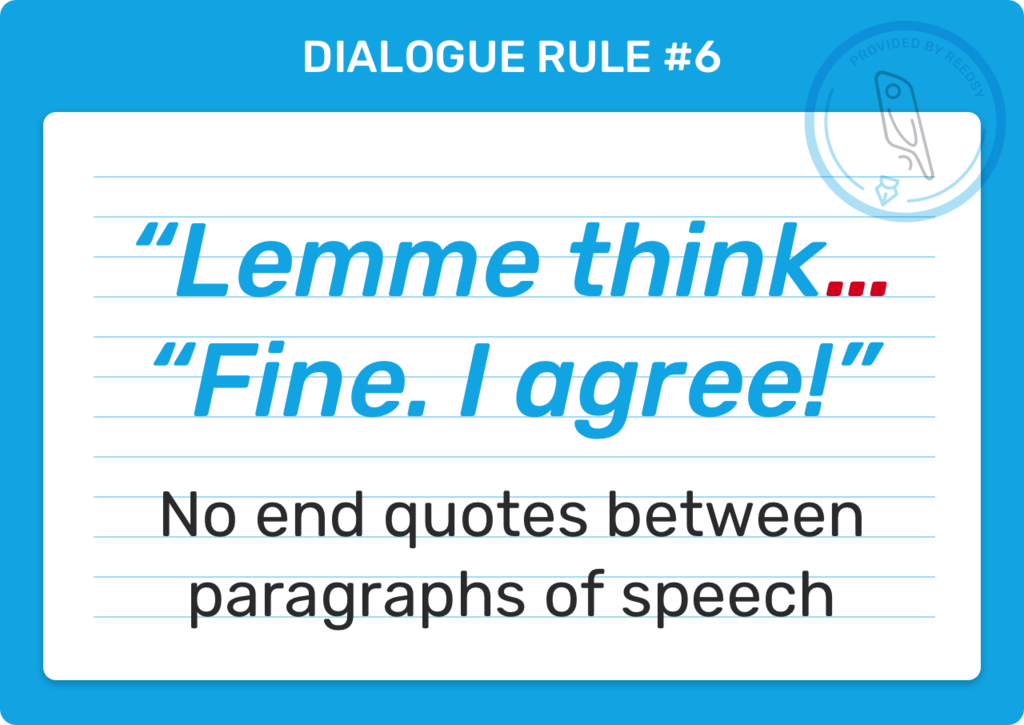
In all the examples above, each character has said fewer than 10 or 20 words at a time. But if a character speaks more than a few sentences at a time, to deliver a speech for example, you can split their speech into multiple paragraphs. To do this:
- Start each subsequent paragraph with an opening quotation mark; and
- ONLY use a closing quotation mark on the final paragraph.
Q: Which authors are known for exceptional dialogue, and what techniques set them apart?
Suggested answer

Short story writers are often masters of the dialogue form because they're talented at packing oceans of meaning/wit/intrigue into a very short word count -- which is exactly what good dialogue is supposed to do. Check out Deborah Eisenberg, who inhabits her characters' heads so fully that they always sound exactly like themselves, in every single line of speech, down to the punctuation marks.
Sarah is available to hire on Reedsy ⏺

I like Nick Hornby for providing realistic dialogue for male characters. He can get into the male mind and convey what men are thinking, in an honest and real way.
Melody is available to hire on Reedsy ⏺

Personally, I really enjoy the dialogue in Diana Gabaldon's Outlander series. Perhaps someone who is more familiar with Scottish accents might disagree, but I think she does a wonderful job showing the differences in where (and when!) a character is from in her dialogue, without going over the top. You can tell that she has chosen each word her characters speak very carefully.
Tracy is available to hire on Reedsy ⏺

In every book that Leigh Bardugo writes, I am in awe of her dialogue. She can write witty banter that feels clever yet realistic, and in moments of tension you can practically see the simmering heat rolling off the words in rage, lust, or high-stakes panic.
Leigh excels at developing her characters with such detail (whether we see it on the page or not) that when they do open their mouths, it's uniquely *them.* You can usually tell who is speaking without reading the character name, and that comes from intense character development.
Grace is available to hire on Reedsy ⏺

You can't go wrong with Robert B. Parker's sharp, punchy dialogue. Chuck Palahniuk is also very good at keeping dialogue crisp. For both of these writers, they don't tend to use a ton of attributive dialogue tags—especially when there're only two people in a scene—and accompanying actions while dialogue is occurring is kept to a minimum, which retains that punchiness.
Brett is available to hire on Reedsy ⏺
Example:
"Would you like to hear my plan?" the professor said, lighting his oak pipe with a match. "The first stage involves undermining the dean's credibility: a small student protesst here, a little harassment rumor there. It all starts to add up.
"Stage two involves the board of trustees, with whom I've been ingratiating myself for the past two semesters."
Notice how the first paragraph doesn't end with an end quote? This indicates that the same person is speaking in the next paragraph. You can always break up any extended speech with action beats to avoid pages and pages of uninterrupted monologue.
Want to see a great example of action beats breaking up a monologue? Check out this example from Sherlock Holmes.
Hopefully, these guidelines have clarified a few things about punctuating dialogue. In the next parts of this guide, you’ll see these rules in action as we dive into dialogue tags and look at some more dialogue examples here.