


 15 likes
 6 comments
The man opposite me had brought three photographs, though nobody had asked him to, and in all three his dog was asleep somewhere inconvenient — under a car, half in a flowerbed, wedged into a gap behind the sofa too narrow for anything with a spine.
"He slept like that every night," he said, and touched the edge of the top photograph as if straightening it might make it more true.
Arthur. A whippet, fourteen years old. Kidney failure, nine days ago.
"Thirty-two percent," the technician said, and the man's eyes went to the display between our chairs instead of to me, which was usual. The rich rarely cried during. They watched the numbers, the way you'd watch a scale, waiting to be told the verdict on something you'd already decided to feel bad about.
The pressure arrived behind my ribs first. It always did — a slow inward push, as though somebody were leaning against a door from the other side. The transfer room smelled the way it always did, cold coffee and something faintly electrical, like a hairdryer left running in another room.
"Forty."
The man exhaled, and above his collar I watched something in his throat move.
I started missing a dog called Arthur.
Not dramatically. Nothing cinematic. I simply knew, with sudden certainty, that he hated rain and would stand beneath the kitchen table rather than go outside in it. That he stole socks but never shoes, and left them in small unexplained piles by the back door. That the patch of carpet beside the radiator was darker than the rest because he had slept there every afternoon for eleven years, and that someone — this man, presumably — had never once moved him off it.
I had never met Arthur.
The man had, for fourteen years, and now his hands were doing something helpless and small against the armrests.
"Stop there," he said.
The technician released the transfer. The pressure stayed exactly where it had settled, a small permanent tenant behind my sternum.
He blinked several times and looked down beside his chair, where a dog was not.
"Well?"
He considered it the way you'd consider a wine you were too polite to send back.
"Better."
That was the word most of them used. Not *lighter*. Not *easier*. Better, as though grief were a fit of clothing that had simply needed adjusting.
The technician removed the leads from our wrists. The man put on his coat, and at the door he stopped and looked back at me properly for the first time.
"Will you miss him?"
"Not exactly."
He waited, the way people do when they suspect there's more and want it handed over gently.
"Fragments, sometimes."
"Of Arthur?"
"Possibly."
"Do they go away?"
"Usually."
He nodded, relieved, and left, and I sat for a moment with a dead dog's habits arranging themselves quietly inside me like furniture in a room I hadn't chosen.
My phone lit up on the side table. FINAL NOTICE. I turned it face down without reading past the first line, the way you might turn down the volume on something you already know the ending of.
In my own kitchen, the toaster had sat broken for two years, its plug curled beside the skirting board like something waiting to be forgiven. I told myself I preferred cold bread. This was, on the whole, a lie I had grown quite attached to.
"Still doing that?" Ravi asked. He was cleaning the contact pads with a strip of gauze, unhurried, the way he did everything.
"Doing what?"
"Pretending letters become less official if you don't read them."
"It's worked surprisingly well so far."
"They're taking the flat?"
"Eventually."
"When?"
"Friday."
He stopped wiping.
"Jesus, Esther."
"It's Tuesday. Plenty of time."
"To invent money?"
"That's currently Plan A."
Ravi dropped the gauze into the clinical-waste bin and looked at me for a second longer than the moment strictly required.
"There's a full transfer waiting."
"No."
"I didn't say who."
"You said full."
"Buitenweg."
I looked at him properly then.
Everyone knew the name. Bert-Jan Buitenweg owned three pharmaceutical companies, part of the rail network, and — according to a magazine that lived permanently in our waiting room — a vineyard he had never once visited. His wife had died six months earlier, and her photograph had been everywhere in the way that beautiful, sudden deaths always are: Lena Buitenweg smiling beneath an umbrella outside some theatre; Lena boarding a plane, sunglasses pushed up into her hair; Lena leaving the private clinic where she would die two days later, a paper cup of something in one hand as though she still had errands to run.
Cancer. Fast. The kind of fast that leaves people looking for someone to blame and finding no one.
"How full?"
"All of it."
"No."
"He's offering eighty thousand."
I didn't say anything. I looked at my phone, face down on the counter, and Ravi watched me look at it.
"That's why I'm telling you."
"I don't do total transfers."
"I know."
"Neither do you."
"I'm not the one being evicted."
My next client had buried his older brother in February and still couldn't walk past a betting shop without wanting to call him. By seven that evening I had agreed to meet Bert-Jan Buitenweg.
*
He came without security, which surprised me more than the suit did, though the suit had probably cost more than my car had before the transmission gave out. He sat opposite me in Consultation Three with both hands flat on his knees, like a man bracing for a photograph.
"You've done complete bereavement before?"
"No."
His expression barely moved.
"Why not?"
"Because forty percent pays perfectly well, and most people find that's as much as they can carry without losing something they'd rather keep."
"I'm not interested in most people."
"I'd gathered that."
He studied me for a moment, unhurried, the way you'd look at something you were deciding whether to buy.
"What happens if you take all of it?"
"I grieve your wife."
"And I don't?"
"That's the basic commercial proposition, yes."
"For how long?"
"Could be months."
"Years?"
"Possibly."
"And then?"
"It usually fades."
"Usually."
"Yes."
He leaned back, and behind him a framed print of a beach at low tide hung slightly crooked — the clinic bought its art in bulk, and every room offered you somewhere you would rather be. Bert-Jan didn't look at the beach. He looked at his own hands.
"You've seen photographs of Lena."
"I have."
"You know who she was."
"I know who the newspapers said she was."
Something moved at the corner of his mouth. It might have been the beginning of a smile, or the end of one — I genuinely couldn't tell, and I found that I wanted to.
He reached for the consent form, then stopped. He straightened the small stack of papers in front of him. Once. Then again, though they were already square.
"She hated that," he said.
"What?"
He nudged the top sheet half an inch out of line, looked at it as though it had betrayed him, and put it straight again.
"That. She used to say I could make a hotel room look audited."
I waited. He picked up the pen and didn't sign anything with it yet.
"What do you need the money for?"
"That isn't relevant to the transfer."
"No," he agreed. "But I'm curious."
"Rent."
"Eighty thousand pounds, for rent?"
"London has become ambitious."
That got him — a real smile this time, brief and involuntary, gone almost before I'd registered it. He signed the first page.
I hadn't signed mine.
"What happens to the rest of it?" I asked.
"The rest of what?"
"Everything that's attached to grief. Love. Habit. Whatever you want to call it."
He looked at me as though I'd asked a question in a language he'd once known and half-forgotten.
"I'm not paying you to take my love."
"You can't separate the ingredients once they've been cooked."
"That sounds unscientific."
"It is."
He picked the pen back up, and for a moment he simply held it, not writing.
"I've had six months of scientific answers," he said, quietly enough that I understood it wasn't really meant for me, and then he signed the second page.
I signed mine.
*
The transfer took four hours.
At sixteen percent, I knew Lena hated hotel pillows — always had, always would now, in me. At twenty-three, I knew she cut her toast diagonally unless she was angry, in which case she cut it into quarters and ate it standing up. At thirty-one, I knew Bert-Jan slept with one foot outside the duvet, always the left, and that she used to tuck it back in without waking.
At forty-eight, I remembered a kitchen I had never stood in. Yellow tiles. Rain against the glass. Lena scraping burnt toast into the sink with a butter knife while Bert-Jan complained, from somewhere just out of sight, that the smoke detector was too sensitive.
At sixty-two, I started crying. Bert-Jan didn't.
At seventy-nine, I knew exactly how she said his name when she wanted him to stop talking — two syllables, flattened, a small closed door of a word.
At eighty-six, he asked if we could go faster. Ravi ignored him.
At ninety-four, I felt a hand in mine. Small. Warm. Hospital light coming in sideways through a blind that hadn't been adjusted properly. A plastic tube taped beneath translucent skin.
*Don't let them make me boring after I die.*
I tried to pull my wrist away. Ravi caught my arm before I could.
"Esther?"
"I'm fine."
Bert-Jan was watching the display, not me.
Ninety-seven. The hand in mine squeezed once. Then stopped.
One hundred. The machine chimed, and for several seconds nobody in the room moved, as though we were all waiting to see whether something else would happen.
Bert-Jan took a breath. Then another. He touched his own face, lightly, the way you'd check for a fever.
"How do you feel?" Ravi asked him.
Bert-Jan looked around the room as though he'd just arrived in it.
"Hungry."
I was sick into the waste bin beside my chair. He transferred the money before he left, and I heard the confirmation chime on my phone from the floor, where I was still sitting.
*
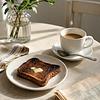
On Thursday I paid six months' rent in advance. On Friday I bought a toaster.
Mine had sat broken for two years, plug curled beside the skirting board like something waiting to be forgiven. I stood in the appliance aisle holding three different models, comparing slot widths I didn't care about, and crying hard enough that an employee in a red polo shirt asked, very gently, if I needed medical assistance.
At home I burned two slices deliberately, on purpose, the way you'd pick at a bruise to check it was still there. I scraped the black parts into the sink with a butter knife I didn't remember owning until my hand already knew where it lived. The smoke detector went off. I laughed — a real laugh, surprising myself — and then I sat on the kitchen floor with my back against the cupboard until midnight, not doing anything in particular, just being in the room with it.
Over the following three weeks, Lena arrived in pieces. Not memories — Ravi had been right to correct me on that word, weeks ago, in a hallway. Preferences. Reflexes. Absences with a shape.
I started buying the expensive marmalade she liked, and gave up halfway through the first jar because I discovered, with something like grief, that I hated marmalade. I woke most mornings with my right hand stretched across the empty side of the bed, reaching for a temperature that had never been there in my own life. Once, on the Underground, I followed a woman wearing Lena's perfume for half a street before I understood what I was doing and made myself stop.
Another time I saw Bert-Jan in an advertisement, opening a children's oncology centre, looking rested in a way that seemed almost professionally managed. *Resilient*, the headline called him. I got off two stops early and walked the rest of the way in the rain, which felt, obscurely, like the correct thing to do.
*
A month later he came back to the clinic. I saw his name appear on Ravi's screen before Ravi did.
"What does he want?"
"Assessment."
"For what?"
"He says something's missing."
I laughed loudly enough that a receptionist looked through the glass. Ravi didn't laugh.
"You should probably sit in."
"I absolutely should not."
"You're carrying the complaint, Esther."
That, unfortunately, was true.
Bert-Jan looked exactly the same. Perhaps slightly better — the kind of well-rested that makes people uneasy rather than admiring. He shook Ravi's hand and gave me a small nod, as though we were colleagues who'd once shared a difficult project.
"Esther."
"You remember me."
"Of course."
He sat, and this time his hands didn't go to his knees. They rested loosely in his lap, unbraced.
"I have a problem," he said.
Ravi opened the file. "You requested a total affective transfer."
"I know what I requested."
"Then—"
"I remember my wife." His voice stayed perfectly level. "I remember our wedding. I remember where we lived. I remember her diagnosis. I remember sitting beside her when she died."
He rubbed his thumb slowly over his index finger, a gesture with nowhere obvious to land.
"But?"
He looked, for the first time since he'd sat down, genuinely annoyed — not at us, I thought, but at the shape of his own sentence.
"I don't understand why any of it matters."
Neither of us spoke. Somewhere down the corridor a door closed.
"I found one of her dresses yesterday," he went on. "I knew it was hers. I knew she wore it in Florence. I knew we argued that night because I'd answered emails during dinner and she'd gone quiet in the particular way she went quiet."
His voice still hadn't moved.
"I threw it away."
My fingers found the edge of the chair and held on.
"You paid for this," I said.
His eyes came to me properly then.
"I paid not to hurt."
"Yes."
"I didn't pay to stop caring."
"What did you think grief was attached to?"
"That's why I came here. To find out whether it can be corrected."
Ravi began to explain partial reversal — percentages, reintegration risk, a phrase about emotional instability that Bert-Jan waved away with two fingers before it was finished.
"How much does she have?"
Ravi hesitated, glanced at me.
"All of it."
Bert-Jan looked at me differently then. Not unkindly. Not cruelly either. As though I were a filing cabinet he'd forgotten he owned, and had just remembered contained something he needed.
"Can I have some back?"
The question caught me somewhere soft.
"Yes," Ravi said, before I could answer for myself.
"How much?" I asked instead.
Bert-Jan thought about it the way he'd thought about the wine-that-wasn't-wine, weeks ago. Carefully. Without hurry.
"That depends."
"On what?"
"What would you recommend?"
I thought of Lena scraping toast into a sink she'd never let me see. Of a small warm hand inside mine. *Don't let them make me boring after I die.*
"Thirty percent," I said.
Ravi turned to look at me. Bert-Jan nodded slowly, as though I'd confirmed something he'd already suspected.
"Would that be enough?"
"To hurt?"
"Yes."
"Probably."
He was quiet for a moment.
"And enough to care?"
I looked at him properly, the way he'd looked at me in Consultation Three, weeks ago, deciding whether to buy.
"That isn't a dosage question."
He stared at the floor for a long moment, as though the answer might be written there in a language he was slowly translating.
Then he stood.
"No."
Ravi frowned. "No?"
"I need to think about it."
He buttoned his jacket, unhurried, and at the door he stopped, one hand on the frame.
"Do you have memories of her? Real ones, I mean. Not just — information."
"Fragments."
"Anything good?"
I could have told him about Florence. About the hospital, the tube taped beneath translucent skin, the way she hated hotel pillows enough to complain about it in three different countries.
"Toast," I said instead.
He waited for the rest. I didn't give it to him.
He left.
*
That evening I booked a removal. The clinic offered staff a discount, and Ravi ran the intake himself, his fingers moving carefully over the screen the way they always did when he thought I wasn't watching him think.
"How much?"
"Half."
He entered it.
"Specific exclusions?"
I looked through the glass wall into the transfer room. The beach print had been swapped for mountains — somewhere else you'd rather be, apparently, though I found I didn't mind the room at all, not anymore.
"Yes."
Ravi's fingers hovered over the screen.
"Which?"
I thought of a yellow kitchen I had never entered, rain against a window I had never touched, and a dead woman laughing while smoke filled a room that had never once been mine, and that I had, somehow, without meaning to, moved into anyway.
"Not the toast."




You must sign up or log in to submit a comment.
I loved the idea that taking someone’s grief also means inheriting the love and tiny memories that created it. Esther choosing to keep the toast absolutely got me—such a beautiful ending. Wonderful read ❤️
Reply
Thank you for reading, liking and commenting my story. That means a lot to me.
Reply
Nicely written. This story evokes memories. The good the bad and those that do not matter. Toast.
Reply
Thank you!
Reply
Beautifully written. Esp the introductory scene about the dog, which is a grief & pain most people can relate to.
Reply
Thank you for your kind words.
Reply