Menu
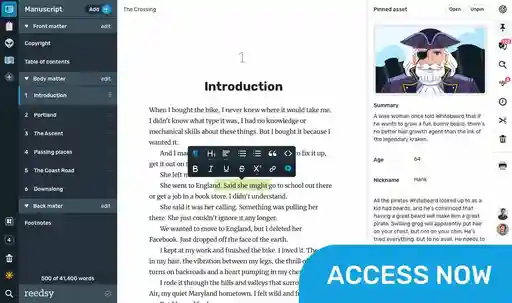
Write your book in Reedsy Studio. Try the beloved writing app for free today.
Craft your masterpiece in Reedsy Studio
Plan, write, edit, and format your book in our free app made for authors.
Write your book in Reedsy Studio. Try the beloved writing app for free today.
Craft your masterpiece in Reedsy Studio
Plan, write, edit, and format your book in our free app made for authors.
DIRECTORY
Showing 15 writing exercises curated by Reedsy.
Come up with three thought provoking questions. Such as:
Sometimes writers think up a character and jump straight into writing, without fully fleshing out the concept at a foundational level. This then means they falter and end up writing a very confused draft. I call this 'The Story Swamp.'Avoid The Story Swamp by writing a 'logline' or 'pitch' of approximately 25-60 words. This logline should cover what B2W calls The 3 Cs:Character: Who is your protagonist? What does s/he need or want?Conflict: Who is the antagonist? Why does s/he want to stop or counter your protagonist? What other obstacles are in your protagonist's way?Clarity: Do we know what genre or type of story this is? Are you using familiar or clich_d language? Are your word choices too vague?
How do you start a story - or get a story back on track? If you're feeling lost or blocked, try templating to get your plot on course.Here's what to do: bullet point your initiating incident, your rising action, your crisis, and your resolution for both your main plot and subplots. Make a table to see events running parallel, remembering subplots exist to enhance, complicate _ ultimately, compliment _ your main action. Listing like this highlights any irrelevancies, keeping your tale on track, and makes all you write intertwined and significant to your protagonist's journey. Plan out using this framework as your reference.
Pick up one of your favorite novels. Open it to a random page. Whatever chapter you land on, rewrite it your own way. Take it in a totally different direction than how it actually plays out in the book.
What is your story's hook? Analyze your opening scene and identify the implicit but specific question it encourages readers to ask. Is this question in the first paragraph or, better yet, the first line? How can you strengthen it?
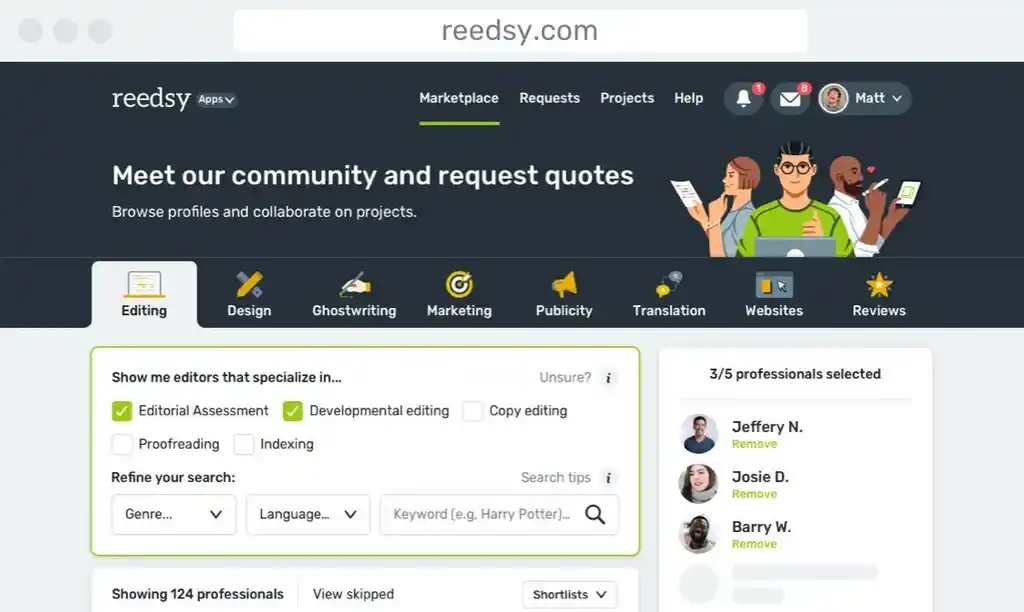
Find the perfect editor for your next book
Over 1 million authors trust the professionals on Reedsy. Come meet them.
We made a writing app for you
Yes, you! Write. Format. Export for ebook and print. All for free.
Enter your email or get started with a social account: