TRY OUR FREE APP

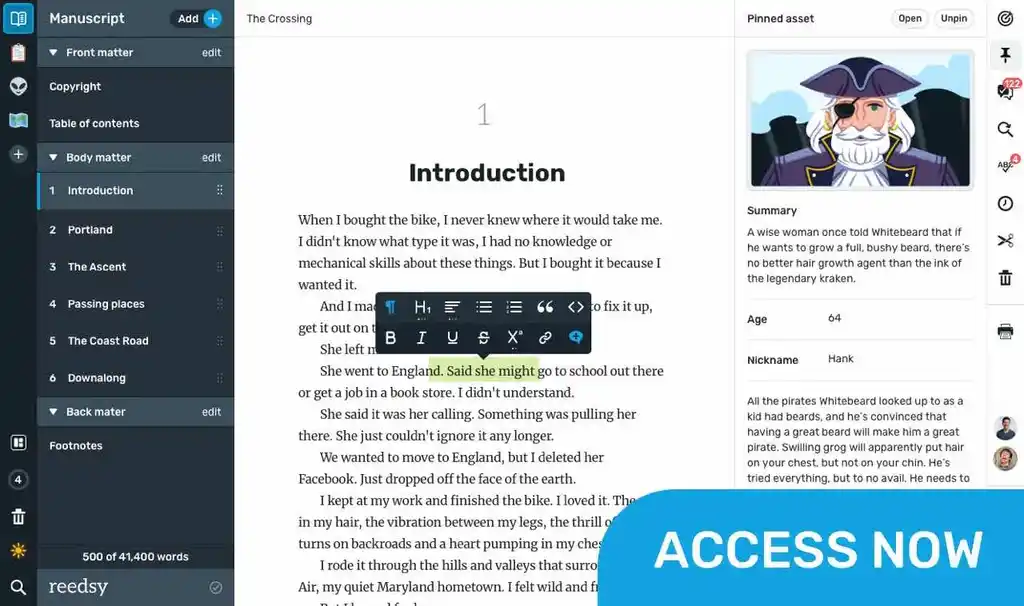
Write your book in Reedsy Studio. Try the beloved writing app for free today.

Craft your masterpiece in Reedsy Studio

Plan, write, edit, and format your book in our free app made for authors.

DIRECTORY

15 Best Plot Development Writing Exercises

Showing 15 writing exercises curated by Reedsy.

The Page-Turner

Plot Development

Have you read a book you couldn't put down? A good writer knows how to keep the reader's attention - and the secret of that is pacing. Take a page-turner and analyse how it kept you gripped. Usually it's because each scene introduced something new, which might be a major revelation or a tiny shift in the way the reader perceives a character. Run through the entire book and write down the purpose of every major scene and turning point.

The Outsider

Plot Development

If you're working on a novel or short story, write a pivotal scene from an outside observer's perspective who has no role in the story.

The Forbidden Prompt

Plot Development

"There is a charm about the forbidden that makes it unspeakably desirable" _ Mark Twain. Your character is doing something someone else has forbidden. Someone else discovers. Will there be a confrontation? Or will the discoverer be so uncomfortable that (s)he will ignore or throw hints instead? This is a great scene to practice tension between two characters as well as the internal thoughts of one of the characters.

Craft your masterpiece in Reedsy Studio

Plan, write, edit, and format your book in our free app made for authors.

Learn more about Reedsy Studio.

Choose Your Adventure

Plot Development

In a "Choose Your Adventure" book, you are forced to make a decision at each and every plot point. The decisions you make will take you down diverging paths and dictate your eventual fate. Try this if you're stuck on a plot development detail in your story. Sketch out the two different paths that a character can experience from one plot point, depending on what action he or she chooses to take.

Alternative Timelines

Plot Development

If you haven't already, write a rough synopsis of where your story might be headed. If you already have a pretty good idea of this, but feel stuck trying to get there, try writing a brief "alternate timeline" of the story you have in mind. Are there fixed, important events that happen in your story? What would happen if your characters made different decisions in those crucial moments?

The Hook

Plot Development

What is your story's hook? Analyze your opening scene and identify the implicit but specific question it encourages readers to ask. Is this question in the first paragraph or, better yet, the first line? How can you strengthen it?

Pride, Prejudice, and Zombies

Plot Development

"It is a truth universally acknowledged that a zombie in possession of brains must be in want of more brains." So began Seth Grahame-Smith's book, Pride and Prejudice and Zombies, which (you guessed it) re-imagined Jane Austen's Pride and Prejudice in a world with zombies. Sometimes one big twist is all it takes to get you thinking about a story in a different way. How would the introduction of zombies shake things up in your world? How would it affect the relationships between your characters? How would it change priorities? Which parts of your world would stay the same, and which parts would be different? Detail this in a short story of 1,000-2,000 words.

The Story Swamp

Plot Development

Sometimes writers think up a character and jump straight into writing, without fully fleshing out the concept at a foundational level. This then means they falter and end up writing a very confused draft. I call this 'The Story Swamp.'Avoid The Story Swamp by writing a 'logline' or 'pitch' of approximately 25-60 words. This logline should cover what B2W calls The 3 Cs:Character: Who is your protagonist? What does s/he need or want?Conflict: Who is the antagonist? Why does s/he want to stop or counter your protagonist? What other obstacles are in your protagonist's way?Clarity: Do we know what genre or type of story this is? Are you using familiar or clich_d language? Are your word choices too vague?

Lost The Plot?

Plot Development

How do you start a story - or get a story back on track? If you're feeling lost or blocked, try templating to get your plot on course.Here's what to do: bullet point your initiating incident, your rising action, your crisis, and your resolution for both your main plot and subplots. Make a table to see events running parallel, remembering subplots exist to enhance, complicate _ ultimately, compliment _ your main action. Listing like this highlights any irrelevancies, keeping your tale on track, and makes all you write intertwined and significant to your protagonist's journey. Plan out using this framework as your reference.

A New Chapter

Plot Development

Pick up one of your favorite novels. Open it to a random page. Whatever chapter you land on, rewrite it your own way. Take it in a totally different direction than how it actually plays out in the book.

Thank you to all our contributors: Almost An Author, Alyssa Hollingsworth, Anne R. Allen, Bang2Write, Christopher Fielden, Darcy Pattinson, Elizabeth S. Craig, Flogging The Quill, Grammar Girl Quick and Dirty Tips, Helping Writers Become Authors, Katie McCoach, Lauren Carter, Insecure Writer’s Support Group, Mandy Wallace, NaNoWriMo, Nail Your Novel, Novel Publicity, One Stop For Writers, Pro Writing Aid, PsychWriter, re:Fiction, The Journal, The Writer’s Workshop, Well-Storied, Women On Writing, writing.ie, Writing-World.com!

RBE | Illustration — We made a writing app for you | 2024-02

We made a writing app for you

Yes, you! Write. Format. Export for ebook and print. All for free.