
After years working in restaurants, it took a global pandemic to remind me that I was a writer.
When I was 10 years old, I was convinced that I was going to become the youngest playwright on Broadway. That’s not quite what happened — but I did manage to have some work produced and published while still in my teens, and received my MFA just after my 25th birthday.
Still, it’s enormously competitive to become a writer; at the time, I felt I hadn’t “lived enough of a life” to write anything worthwhile. I blinked and suddenly I was a 29-year-old restaurant server in Chicago.
Finding inspiration in isolation
After getting furloughed from my serving job because of the pandemic, I told myself that it was time to try writing again. Serendipitously, that month, my friend Alice posted about an open “cabaret” writing space hosted digitally through her theater company. I reached out and asked if I could join. We’ve been meeting nearly every Monday since the spring of 2020, and we’re still going strong nearly six years later.
The group consists of roughly 14-16 dedicated writers. Some have been there since the beginning; others have come and gone. We meet through Zoom, which might sound a bit impersonal — but it’s allowed us to be vulnerable with our writing in ways that would’ve been difficult in person.
We tried many things as prompts in those first few years. We’d look at a painting and write about how it inspired us. We’d experiment with three- to five-letter sentences. Eventually, we started using Reedsy’s creative writing prompts in September 2021.
When we’re ready to write, Alice will read out the entirety of that week’s Reedsy Prompts email. Then she pastes each individual prompt into our Zoom chat, giving us twenty minutes to write. The main thing is to get out of your own way and allow inspiration to take over. The minutes go by fast, and you can’t overthink it.
Some enjoy focusing on one prompt, some incorporate them into their current project, and a select few try to do all five prompts in one piece of writing as an added challenge.
A poem becomes a play
In the fall of 2022, I kissed a stranger in a bar, and my first thought afterwards was: He shouldn’t get involved with me. I’m a cactus.
I mused on this feeling for a day or two — when I next joined the Zoom room for Writers Cabaret, our Reedsy prompts were inspired by Jennette McCurdy’s memoir I’m Glad My Mom Died.
While listening to Alice read the prompts from Contest #161, I jotted down words that jumped out at me. That week, my notes were fairly simple:
“i’m glad my mom died
not least
deep into
child actress
pressure of stardom
a secret is shared
comfort in an unexpected place
charmed life that sucks
heavy responsibilities
face their past to move on”
Later that night, I wrote a poem about feeling like a cactus, which said in part:
“never appreciated water before
always preferred a drought
not having enough feels normal
having too much feels like torture
go on
touch me now
i dare you”
One of my fellow writers asked if the poem could be the seed of a play. At first, I resisted — but within that week I had planted that idea, fertilized it, and the first few pages of my play this dry spell swiftly sprouted.
The play follows Grace, a non-binary artist, who falls in love after kissing Brahm, a musician who’s come to Arizona to become a cactus (literally). Ultimately, Grace goes on a journey to love themselves, even as everyone else questions their attraction to the cactus and expects them to fall into heteronormative patterns.
It’s clear to me from looking over my notes circa 2022 that I was relentless in my pursuit of the story. Many of my play’s scenes were composed in response to several Reedsy prompts — nearly each week of prompts from Contest #160 to Contest #172 has corresponding Notes files where I was working out certain scenes.
Some of this was subtle; in my notes for Contest #163, I simply quoted “explored contradictions” and “power, history, society.” These elements became central to developing my play’s antagonist, Jeremy.
Meanwhile, the notes I wrote around Contest #164 inspired another scene, in which Grace gives their art students an assignment while the students interrogate Grace’s pronouns and where they’ve come from.
Perspiration and persistence
The play poured out of me very quickly. I believe part of that was because my writing group gave me a weekly space to share. Another part of it was simple consistency. I treated each week as an opportunity to share more, explore more.
I grew confident that this play was maybe the best I had ever written. In October 2022, I requested a slot with Chicago Dramatists in their First Draft series before I had even completed my first draft. By the end of November, we had the first reading over Zoom.
I continued sharing my play with other audiences, such as one in Memphis, TN, with Voices of the South. That reading had non-binary performers as the central couple and sparked an intriguing discussion about whether or not non-binary people could be sexual beings. As a non-binary person, I found this fascinating — I wanted to write a complicated, conversation-starting play about sexuality and gender, and the strong response showed that I had succeeded.
Then another opportunity arose: I saw that I could submit to the Yale Drama Series 2023 and that the judge was Jeremy O. Harris. I was a big fan of his Tony-nominated play Slave Play and the film Zola. He’s a kindred spirit, I thought to myself. He’s inventive. He’ll love my play. I took one last look at my draft and polished it before submitting my work in June 2023.
While waiting to hear back about the results, I sent my play to different theaters. I found myself drowning in a wave of no’s — it was depressing to hear such apathy from theaters I respected.
Though I hadn’t consciously crafted the play this way, it became clear to me that I wrote it to process my feelings as a sexual assault survivor. It’s why I find romance with a cactus to be safer than that with an actual man. It’s why my play is critical of romantic comedies and why it’s ultimately more of a self-love story. I wrote my play to reckon with how I’m a hopeless romantic who nonetheless finds the idea of romance dangerous.
In June 2024 — around a year after I submitted my work to the Yale Drama Series — I was beyond surprised when I received an email with the subject line “YDS.” I thought it was spam. I opened it and was met with the phrase, “Guess what? Jeremy O. Harris has chosen THIS DRY SPELL as the new winner of the Yale Drama Prize.”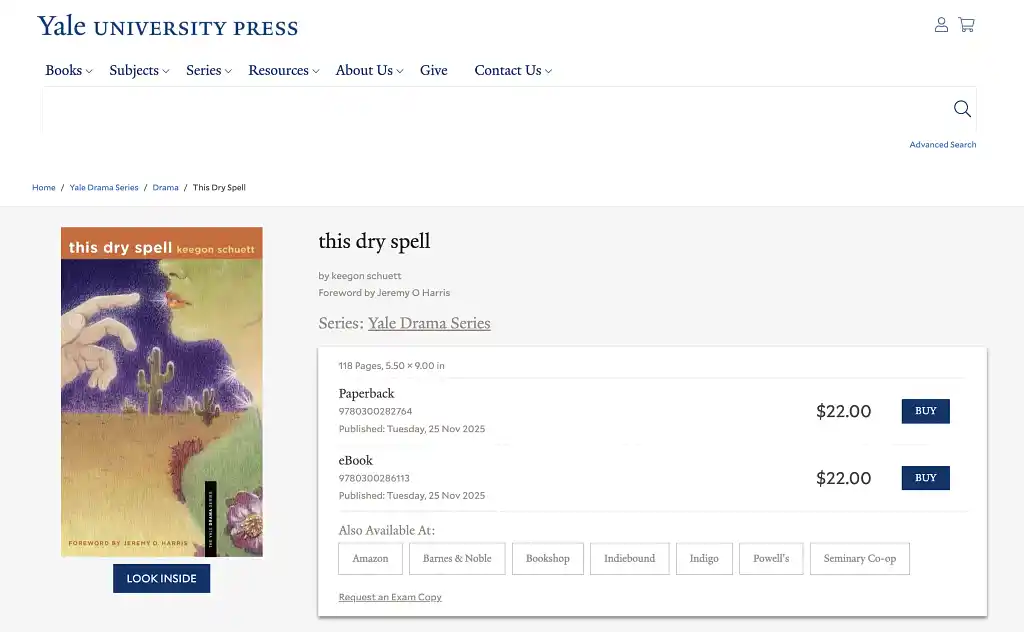
The play flourishes
One of the most memorable readings of my play after that was the celebratory reading at Yale with a cast made up of my friends. I was so moved by the entire experience, and I was particularly thrilled that my mother and sister were able to attend the reading. I got to publicly thank my mother for supporting me as an artist since I was a child.
Around a year later, in the fall of 2025, there was an industry reading in New York City produced by Regular People — with Liv Hewson (Yellowjackets, Santa Clarita Diet) playing the lead role of Grace.
This experience broke the play open in exciting ways for me, mostly due to Liv’s careful, thoughtful interrogation of Grace’s story. Liv proved with ease what I’ve always believed, which is that a great actor will always improve your play.
What’s next for me
This January, Voices of the South will be producing the world premiere of this dry spell with a team of artists I love and respect, and I’ll be flying to Memphis to see their performance on Valentine’s Day. It’s overwhelming to consider how long the writing process can be — all previous iterations of my play were only readings, not full-on public performances! — but I’m thrilled that it’s led to this place.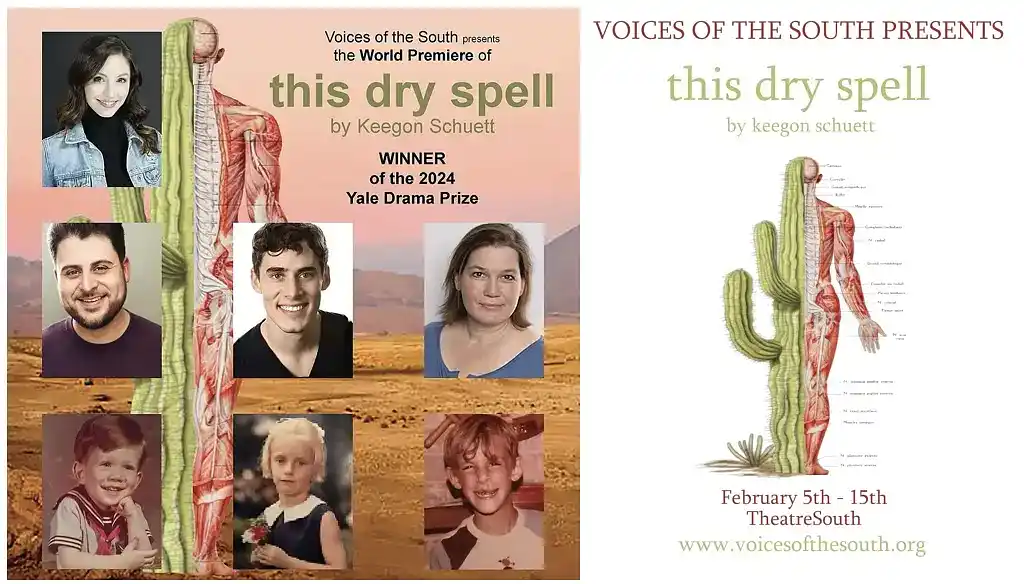 I hope that one day, some creatively inclined kid reads my play and it sparks their imagination — which is just how I felt after reading Tony Kushner’s Angels in America.
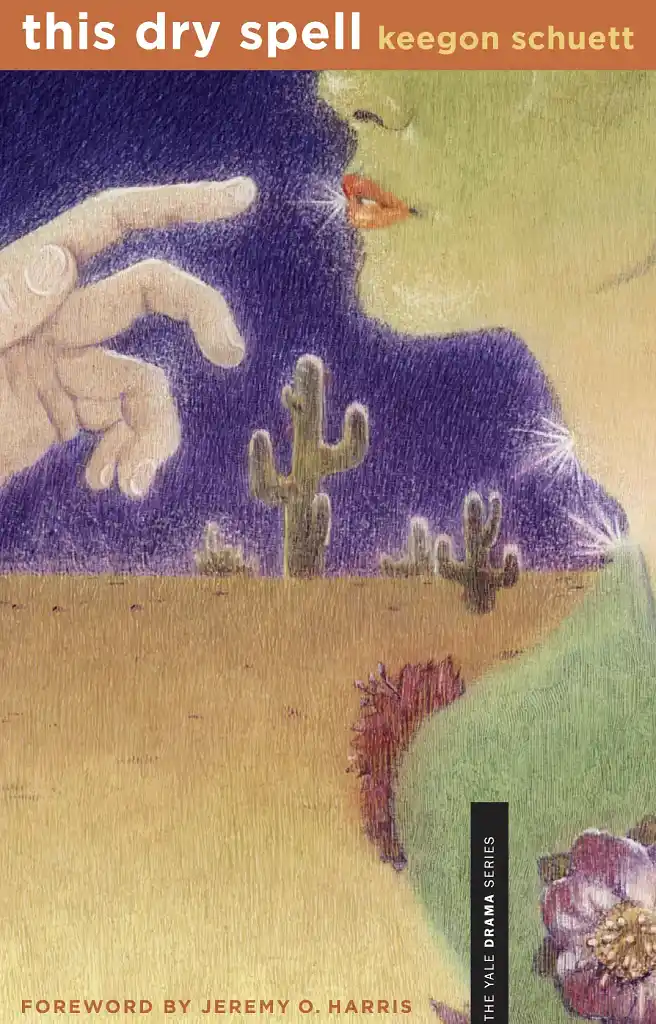
Thanks to the Yale Drama Prize, this is now even more of a possibility. I recently received complimentary copies of my play from Yale University Press, with gorgeous cover art from artist Harrison Wood Hsiang. Now, I’m collaborating with Emily, his brilliant sister, on a new musical about the Minotaur. Sometimes writing can feel like a solitary art, but in my experience, it’s all improved through sharing.
I have written so many pieces since that intial poem in 2022 that became my award-winning play, and I’m here to tell you to keep on writing. Your voice will find its home, and you cannot be the person who rejects it first!
Give yourself time to succeed. My play is published today after three years of hard work, and I’m living proof that consistently writing is the most important thing. I keep myself open to inspiring new prompts each and every week. You could, too.
Read more about Keegon and their work at KeegonSchuett.com