
Guides • Understanding Publishing
Posted on Dec 11, 2025
Self-Publishing vs Traditional Publishing: A Guide for Writers

Francesca Catlow
Francesca Catlow is the author of The Little Blue Door and Under a Greek Sky. She writes bestselling fiction filled with passionate love stories and has been nominated for multiple awards, including the 2023 Kindle Storyteller Award.
View profile →If you want to publish a book, there are two routes you can take — traditional publishing or self-publishing. With traditional publishing, a publishing house handles production and distribution in exchange for royalties; with self-publishing, you retain full control and profits but manage everything yourself.
We’ll start with a table to compare the main differences between the two: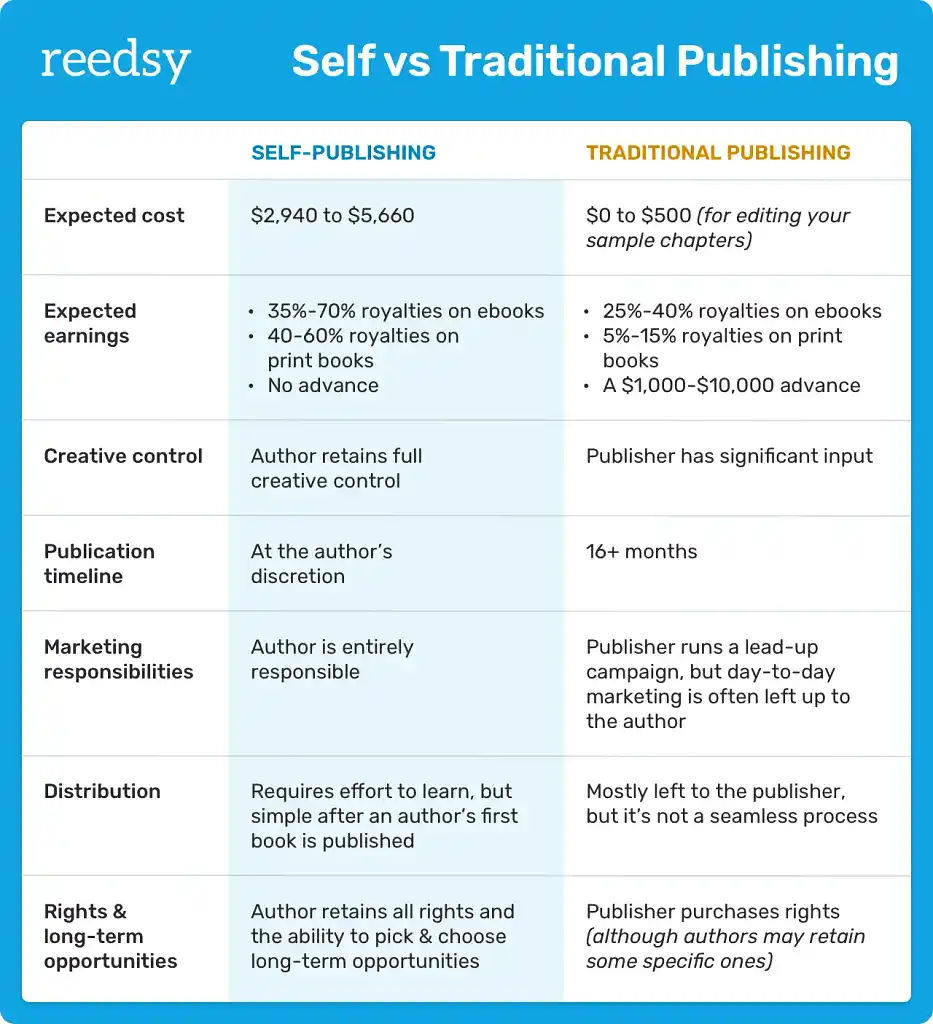 I’ve self-published and traditionally published my books, so I can walk you through both of these processes to help decide which path is right for you. In the past five years I have:
- Self-published six books
- Traditionally published two books
- Sold over 200,000 copies across my catalog
- Been a finalist for the 2023 Kindle Storyteller Award
Let's begin!
Expected cost & earnings
Traditional publishing costs nothing — but royalties are lower
When you sign with a traditional publisher, they’ll take on all financial responsibilities for your book. You’ll also be paid an advance on your book sales (averaging around $1,000 to $2,000 for smaller presses and $5,000 to $10,000 for larger ones.)
This advance usually indicates how well they think your book will sell, though not always. Some publishers, for example, have standard rates for each genre. It’ll also depend on the publisher’s size, the competitiveness of your genre, and your existing author platform.
Once your book is published, you'll receive a percentage of the net profit for every copy sold — but you won’t get anything immediately, because your royalties go toward paying back your advance first. So if your advance was $5,000, you won’t receive any additional royalty payments until your book has made $5,000 in net profit. Failing to “earn out” your advance can also affect your ability to get a second book deal — even with a totally different publisher.
Pro tip: To improve your prospects, I highly recommend paying for a professional edit before querying. Aim to professionally edit at least your first three chapters. You’re much more likely to get a response with a well-manicured manuscript.
Self-publishing can be costly — at first
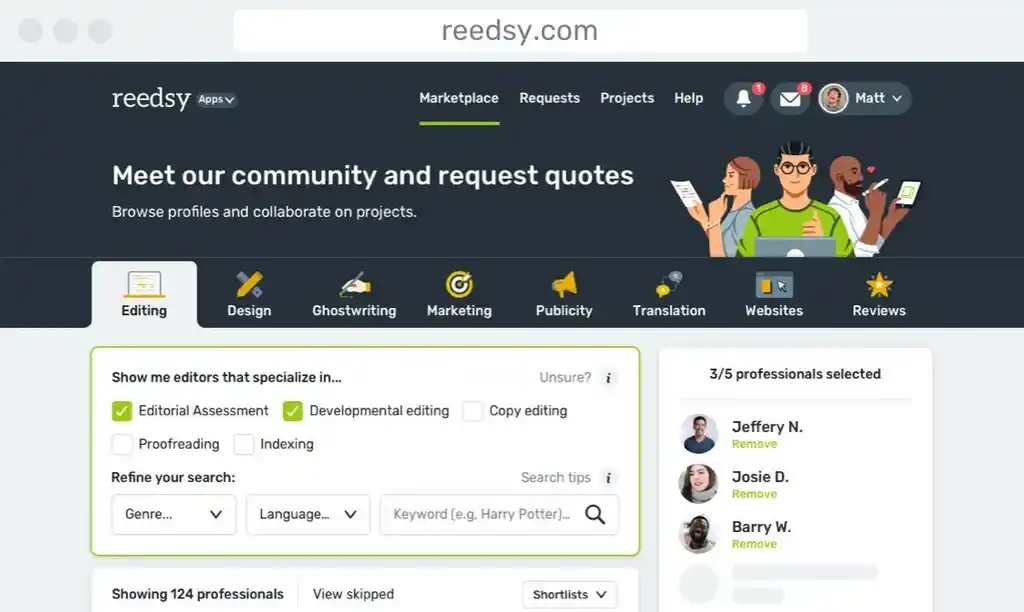
Editing, formatting, cover design, and marketing are all crucial parts of the self-publishing process. If you’re an independent author, you’ll either need to handle these yourself, or hire some professionals to help.
Reedsy provides something I wish I had when I was starting out — a cost calculator that breaks down how much you can expect to spend on each editing service:
Pricing calculator
Calculate the average cost of editing services for your genre.
Editorial Assessment
Developmental Editing
Copy Editing
Proofreading
These costs might seem significant, but think of it like starting a business: you need to spend money to make money, as it were.
On the bright side, self-published authors take home a much higher royalty percentage than their traditionally published counterparts. If you self-publish, royalties are typically between 35% and 70% for ebooks, and 40% to 60% for print books (Amazon actually represents the higher end of these ranges.)
So while it may be pricier upfront, the higher royalty rates mean that self-published authors will earn far more per book sold. And remember, investing in a high-quality final product means you’re more likely to sell more copies (and make more money) in the long run.
Q: What steps can authors take before hiring editors to reduce editing costs while maintaining quality?
Suggested answer


Share your finished work with a range of trusted people, ideally those who are your target readership (not only people you know). These are called beta readers, test readers or advanced copy readers. Have a few questions prepared for your blindspots (Is character A convincing? Is there enough/too much cross-referencing to the glossary? Am I overusing any words? What do you think of the X, Y, Z? Is the dialogue in Chapter X convincing?). Rewrite your draft with brave attention to the feedback, but keeping true to your author's voice, and then send it to a professional editor.
Alex is available to hire on Reedsy ⏺

To help manage costs as well as to speed your book to completion, you can familiarize yourself with the various kinds of editing and target your request accordingly. Reedsy has some great educational material on this. I've noticed that many authors will check both "copyediting" and "proofreading" but often that's because they think they're synonymous. They're related, but not the same. The same editor could probably do both or either, but you shouldn't have to pay for two stages if you only need one.
Eric is available to hire on Reedsy ⏺

At the easiest and most basic level, do a spellcheck, ensure consistency in usage of terms etc, and fix obvious layout/format issues. Also, if you're concerned about wider things like whether your book is interesting or clear enough, give the manuscript to some smart friends or colleagues to get their feedback before sending to an editor
John is available to hire on Reedsy ⏺
Creative control
Traditional publishers can curb your creative control
They say that two heads are better than one, and in traditional publishing, you get exactly that: access to a team of experienced in-house professionals.
Unfortunately, another idiom is also appropriate here: too many cooks spoil the broth. The more people involved in your book’s production, the more creative compromises you will have to make.
This often means ceding control on things requiring market research and technical knowledge, like marketing and cover design. For some authors, it can be tough to grapple with… especially if the strategy diverges from how you see your own story.
Now, this doesn’t mean you’ll get zero say throughout this process. I was fortunate to work with a great, receptive team at Lake Union for Under a Greek Sky; I disliked the initial cover design they sent over, so they changed it in line with my suggestions. But not every author is so lucky!
If you’re concerned about losing creative control, make sure to carefully read over a contract before you sign it. Ideally, you should also speak to the team, ask about their recent work with authors, and assess how likely they are to listen to your opinions. If they seem inflexible, I’d think twice about signing.
Retain full control with self-publishing
With self-publishing, it’s simple: creatively speaking, you’re in charge of absolutely everything, from what goes on the page to what your cover looks like.
That’s not to say you should ignore the feedback from your own editors and designers. But they’ll work toward realizing your vision — so you shouldn’t have any stressful power struggles in the process.
Read more here about my own “creative control” experience with The Little Blue Door.
Hire an expert

Siân H.
Available to hire
Commercially-minded & supportive editor with experience publishing bestsellers. I work with everyone from Big 5 publishers to debut authors

Ellen T.
Available to hire
CAREER COPY EDITOR/PROOFREADER, 25+ YEARS’ EXPERIENCE. Fiction, nonfiction, screenplays. Worked for Kirkus/CreateSpace, Scholastic + more.

Annette C.
Available to hire
Author (Little, Brown, Audible) with 7+ years in publishing. Clear, incisive feedback for romance, women's fiction, thrillers, YA and more.
Typical publication timelines
Traditional publishing takes two years or more
When you sign with a publisher, you’ll be given a preliminary publication date — often around two years in the future. That timeline may leave you wondering: why the long wait?
Well, as we’ve just discussed, traditional publishing involves working with a team to turn your book into a top-notch title. While their input is helpful, it can also be time-consuming… and at times, outright frustrating.
Q: Is it appropriate to follow up on a query letter, and how long should an author wait before doing so?
Suggested answer

It depends on the agent. Many of them will post their specific guidelines on their websites—some will say that you can follow up in <x> weeks, and others will say that, if you haven't heard back from them in <x> weeks, to consider it a pass. If such information isn't on their website, it's a bit up to you, but I've heard ~3-4 months can be a good guideline to follow for query follow-ups. But definitely make sure that the agent doesn't have their specific timelines posted anywhere!
Chelsea is available to hire on Reedsy ⏺

Sure, there's no harm in following up, as long as you aren't being a pest about it.
Most agents have set response times, and may say something along the lines of "expect a response in 6-8 weeks". It's not appropriate to follow up before that window, and it also doesn't help to follow up more than once.
If an agent's website or query page say that it's an automatic rejection after that time frame, then you should take them for their word and consider your query rejected if it goes past that window.
Matt is available to hire on Reedsy ⏺
I believe it's perfectly appropriate to follow-up to a query letter, but keep the following in mind:
Read the agent's submission requirements on their website or social media account. Often, they will tell you their turnaround time or any special considerations. "If you don't hear back from me within two months, email again."
They also might say, "If you don't hear back within two months, it's a no from me." In which case, don't follow-up.
If there isn't a time listed, I would recommend nudging in four to six weeks.
And remember: be polite! Agents are human beings with *feelings* and receive hundreds of submissions. They will consider each one of them in due time.
Grace is available to hire on Reedsy ⏺
For some people, the endless emails between you, your agent, and the publisher’s team can be exhausting. I don’t have an agent, so my communications with Lake Union were slightly more streamlined — I was able to go straight to my editor with questions. (Of course, for most authors, having an agent to mediate is a good thing overall; it just takes up more time.)
Other factors can delay your book’s release as well. Even small publishing houses work on a handful of titles a year, and bigger ones work on hundreds of them. Your book must be slotted into their wider publication and marketing schedule, meaning you’ll likely have to wait at least a year before your work is published — and that’s the best-case scenario.
Pro tip: Keep in mind that some genres/types of books get published more quickly. Timelines for fiction, for example, tend to be faster than non-fiction — more like 16-18 months for fiction as opposed to two years for nonfiction.
Self-publishing can be as fast (or as slow) as you like
Once again, things are a lot more straightforward with self-publishing. The only time constraint is how quickly you (and any professionals you hire) can get things done.
Most authors will plan their launch for as soon as they can reasonably finish their book. Of course, you may still wait for a certain time of year to launch (like wintertime if your book has a seasonal backdrop), but you always have the option to publish whenever you want.
Marketing responsibilities
Traditional publishers handle less than you might expect
As part of a traditional publishing contract, you’ll typically be assigned a publicist. They’ll be responsible for securing book reviews, arranging media opportunities, and distributing advance reader copies (ARCs) to major publications. You’ll also work with a wider marketing team on additional materials for your book.
When I worked with Lake Union Publishing for Under A Greek Sky, they:
- Distributed ARCs on NetGalley.
- Secured me an invite to a TikTok course with Tandem Collective (which was particularly exciting!)
- Helped create marketing materials for my newsletter and social media.
- Set up advertising on major platforms and ran promotional deals on my ebook.
I had a great experience with Lake Union, but even with all their help, I was posting on social media myself, drafting my own newsletters (with their additions,) and engaging with readers personally. At the end of the day, I was the one representing my book… and this would be true at any publisher, with just about any title.
Based on conversations with other trad pub authors, I know that levels of marketing support can vary hugely. I was lucky with Lake Union, but some authors get far less help. I’ve had several trad pub authors reach out to me for help running their own Facebook ads, which is always a bit shocking.
All that to say: even if you land a publishing contract, don’t expect the marketing process to be a breeze. You’ll still need to “show up” regularly for your book to be a success.
Self-published authors are 100% responsible for marketing
If you choose to self-publish, expect to show up tenfold. Indie authors need to cold-pitch other industry professionals, learn how to use advertising platforms like Amazon, build relationships with book bloggers and podcasters, and manage all the business infrastructure themselves.
Getting to grips with all this can be difficult when you’re first starting out, but it won’t stay that way for long. I recommend connecting with other authors (on social media and in real life) and employing marketing pros to help you learn the ropes.
Q: Should authors sell exclusively on Amazon?
Suggested answer

It depends on your ultimate career/business goals. A book that is only published on Amazon looks like a self-published book. For non-fiction, if your goal is the elevation of your thought leadership status, you benefit from your book being "everywhere". Including links to numerous retailers on your website is not a traffic flow exercise, where we are trying to spread out your sales - it is a branding exercise. We want to show the prospective reader, or podcast host, or convention booker that your presence is as far and wide as possible. Widespread distribution increases perceived legitimacy.
Chris is available to hire on Reedsy ⏺

In the children's book world, an author selling their book only on Amazon is not ideal for several reasons. Most advance trade review outlets will only review books that have a broad distribution, or at least are sold also in bookstores or non-traditional book outlets. Also, selling only on Amazon largely cuts out the school and library distribution, which typically use wholesalers. Amazon, in my opinion, is an important part of book sales, naturally, due to its huge marketshare of children's book sales, but best done in conjunction with other sales and marketing opportunities.
Tara is available to hire on Reedsy ⏺

For most authors—especially if you’re just starting out—selling exclusively on Amazon is a smart move. Managing multiple platforms can be overwhelming, and Amazon’s KDP Select program gives you some great tools to build momentum. Page reads from Kindle Unlimited and features like countdown deals make it easier to get your book in front of readers without spreading yourself too thin.
That doesn’t mean you’re stuck with Amazon forever. Once you’ve got some traction—like more reviews, a growing fanbase, or even a backlist—you can start exploring other platforms or even direct sales. But starting with Amazon keeps things simple and helps you focus on what matters most: reaching readers and building your audience.
If you’re new to publishing, Amazon isn’t just a platform—it’s the best foundation to launch your career.
Jd is available to hire on Reedsy ⏺
When I was promoting The Little Blue Door, I reached out to my local radio station to see if they'd be willing to talk with me about it. The first interview was over the phone, but it went so well that I was invited back to be a sofa guest!
One more thing I want to mention here is how vital social media has become for modern book marketing. Building a personal connection with readers through platforms like TikTok and Instagram will help generate organic buzz around your book. If you can get people talking, you can get them buying.
Pro tip: Aim to post on your social media platform of choice at least once a week. As you get closer to launch day, ramp up to 3-5 times per week. Exposure is critical and consistency is key!
Distribution options
Traditional publishing can get you into brick-and-mortar stores
A traditional publishing deal is generally (though not necessarily) a safer path to bookstore shelves.
Here’s how it works: publishers provide bookstores with catalogues of their upcoming releases, which then stock the titles that they find most appealing. A publisher may also pay upfront for window displays and table space in bookstores, though this is mostly reserved for bestselling authors and highly anticipated new releases.
And indeed, a publishing contract doesn’t guarantee shelf space. Some publishers don’t push their new acquisitions as hard as their tried-and-true authors, and some books (including my own!) have other distribution issues that make them difficult to stock.
This hasn’t really bothered me, partly because I’ve forged my own relationships with local booksellers for regional distribution (see more on this below). However, if you want to be stocked in stores across the country, then signing with a Big 5 imprint is the way to go.
Q: Assuming a book deal, how long can an author assume the process will take from querying to seeing their book on the shelf?
Suggested answer

Having been an acquisitions editor for a division of Random House, I can tell you publishing is a marathon, not a sprint. On average, the journey from query to bookstore shelves is about two years. That might sound like forever, but every step along the way has its own milestone worth celebrating.
Here’s what it looks like:
- A Spark. An editor loves your query! Cue the happy dance. They’ll ask for more—maybe a full proposal, sample chapters, or even the whole manuscript if it’s fiction.
- The Back-and-Forth. This is the “let’s make it even better” stage. You might be asked for clarifications or revisions before your project goes to the publication board. Think of it as a friendly brainstorming session with high stakes.
- The Green Light! Once the pub board approves, a contract is drawn up. Negotiations and signatures can take 2–3 months. Then it's official and you can make announcements in public.
- The Writing Zone. You’ll usually get around six months to deliver your manuscript. This is when the real writing (or rewriting) magic happens.
- The Editorial Polish. Once you submit your manuscript, your editor helps refine your work. Developmental edits, line edits, copyedits… it’s like giving your manuscript a deep massage. This adds another 2–3 months.
- The Final Stretch. Your book is typeset, proofread, and sent to print. Depending on where it’s printed, this can take another couple of months.
- Meanwhile, the sales and marketing teams are busy building buzz, and you are stirring up excitement with pre-sales posts.
So yes—it’s a two-year adventure. But the good news? That “long runway” gives publishers time to rally booksellers, reviewers, and readers, so when your book finally launches, it’s not just quietly slipping onto a shelf or into the Amazon masses, it’s arriving with fanfare. Publishing is a process of patience, persistence, and plenty of celebratory moments along the way.
Alice is available to hire on Reedsy ⏺

Querying is the first step of a journey through traditional publishing. After you've sent out your queries, the next steps might look something like this:
- Full requests: Literary agents who are interested in your query will request the full manuscript from you so they can read the whole book and decide whether to offer representation.
- Offer of representation: After reading your book, the literary agent has decided they would like to represent you and take you on as a client, so they send you an offer of representation. This is a good time to follow up with any other pending queries and let them know that you've received an offer of representation. Generally, you should give other agents 2 weeks to get back to you after you've let them know you've received a competing offer of representation.
- Submissions: Once you've signed with a literary agent, your agent goes out with your manuscript on submission. This might happen right away (if your agent believes your manuscript is ready) or after a round or two of revisions. The amount of time this might take varies greatly.
- Editor interest: Editors who are interested in your book may have to drum up internal support at their publishing house before they can make an offer. This could look like the editor bringing the project to their editorial meeting, then presenting it at an acquisitions meeting. This could take up to 2 weeks depending on the process at that particular publishing house. You may have a call with the editor as well to make sure your visions are compatible.
- Book deal offer: Your prospective editor will send an offer to your agent, and they will negotiate.
- Editing begins: Once you've come to an agreement on the book deal, you will begin working with your editor. All in all, it generally takes about 2 years between a book deal and the book's publication date. This looks like about 1 year of editing and revising, and then 6 months of the book moving through different stages of production, and then it goes out to the printer, is physically produced, and ships to distributors, who then sell to booksellers, who then stock the book.
Of course, the timelines for the items I've listed here vary greatly. But generally speaking, it's safe to assume at least 2 years between book deal and publication...plus the amount of time you've had between querying and getting that book deal. This is part of the reason I encourage authors not to chase trends and instead to focus on writing compelling characters—traditional publishing is slow, so write from the heart. Strong character work and a good command of craft will appeal regardless of the shifting trend cycles.
Christine is available to hire on Reedsy ⏺

Allow a publisher's editorial board 30 - 60 days to finalize an offer and negotiate details. After that, expect 8 to 16 months before your cover sees the light of day. Why so long? Legitimate publishers allocate marketing and trade sales resources on their calendar. They also sometime like to schedule titles based on best selling seasons for a particular genre.
Mike is available to hire on Reedsy ⏺
Self-publishing can too — but it depends on you
You probably know the score by now: if you choose to self-publish, book distribution will rest entirely in your hands.
Indie authors will need to start by setting up ebook distribution for digital copies. I’ve chosen to sell my self-published ebooks on Amazon exclusively so I can reap the benefits of their KDP Select program, but some authors prefer to “go wide” with other, non-Amazon retailers. That can work well too — you can read all about ebook distribution options here to help you make the right call.
Next up is, unsuprisingly, print distribution. Traditional publishers may have strong networks for print, but that doesn’t mean it’s impossible for indie authors to get their books on store shelves — and I’m the perfect case study for this.
I began by approaching my local Waterstones branches with the following fact sheet:

Following a pleasant conversation with the store manager, they were happy to feature The Little Blue Door on their shelves — and all my other self-published books as they came out.
It was a similar story when I visited my local independent store (Dial Lane Books in Ipswich, UK). Not only did they stock my books, but they even agreed to host a book signing event for me.
I will say, again, that I’ve been pretty fortunate with my experience. Not every self-published author will meet with such receptive sellers (especially the big chain bookstores,) but it’s absolutely worth a try. Having high Amazon ratings, a beautiful cover, and a professional approach will open more (little blue) doors than you might expect.
Q: What are the most common mistakes authors make when pricing their self-published books, and how can they avoid them?
Suggested answer
A big mistake I see authors make is not thinking through how their pricing affects readers. If you price your book too high, you risk scaring people off. If it’s priced too low, readers might assume it’s not worth their time. Finding the right balance—what I like to call the “sweet spot”—is so important.
The best place to start is by looking at other books in your genre. What are they priced at? This gives you a good idea of what readers are willing to pay. Temporary promotions, like dropping your price to $0.99, can help boost visibility, but I don’t recommend staying there. It’s easy to get caught in a “race to the bottom,” where constant discounts make your book feel less valuable.
As your book gains credibility—through reviews, awards, or just word of mouth—you can raise your price to reflect that value. Pricing isn’t just about numbers; it’s about showing readers that your book is worth their time and money.
Jd is available to hire on Reedsy ⏺
The most common mistake authors make when pricing their self-publishing books is not pricing it so that they are covering all of their outlaid costs. Some authors only look at comparative titles in the marketplace and how they are priced. Indeed, this is an important step in figuring out what to price a book, but if you are not making a return on investment to at least to recoup your spend, not to mention a profit, then your list price is failing you.
Tara is available to hire on Reedsy ⏺

My answer, as usual, is based solely on Amazon, where 80-100% of sales happen for most authors.
1. Missing KDP's thresholds for Kindle
Amazon pays you 70% of the retail Kindle price - if the price is in the range $2.99 - $9.99.
If the price is lower than $2.99 or $10 and higher - you will receive only 35% in royalties.
Kindle book which is more expensive than $10 and below $29 has no economic justification from the self-publishing point of view.
2. The same price for the paperback and Kindle
Those are two distinct products. Kindle should be cheaper than paperback. There are no production or distribution costs involved for an eBook.
Plus, Amazon customers are trained to expect cheap and discounted stuff, especially for such a flagship category like Kindle books.
3. Pricing too low
This happens more with hard copies. In 2025, Amazon introduced new royalty structure: 50% royalties for books cheaper than $9.99, and 60% for $9.99+ books.
The trick is in fine print, as usual. Those percentages are counted after deducting the printing (and distribution) fee. So, when the same book costs $8 or $12, your royalties will be dramatically different. Let's say the printing cost is $3: in the $8 scenario you will get half of the five dollars; in the $12 scenario, you will receive 60% of nine dollars ($2.5 vs. $6).
Avoid the less-than-$9.99 price range, unless you have particularly good reason to price your book so low.
With Kindle there is a dramatic difference between $2.99 book and $2.49 book because of the thresholds mentioned in point #1 (about $2 vs. 87 cents).
Personally, I find only one price point below $2.99 worth trying: 99 cents. It is good for entry point of a series or for promotional purposes.
4. Pricing too high
It applies especially to Kindle format. First, because the royalties’ thresholds penalize higher prices. Second, because Kindle readers are cheap.
First-time authors think: "It's just $5, a price of the coffee, surely people will be willing to buy my book." They forget that they don't sell coffee, but eBooks. Amazon customers have millions of other titles free or priced incredibly low to choose from.
In case of paperbacks, it is more about the subject matter and length of the book. If you try to sell your 70-page novella for $20, good luck. Non-fiction books solving specific problems are more "justified" to cost more.
In the fiction genres the competition is fiercer. Readers have plenty of alternatives, so if you overdo your price, they may skip your book and pick your competitor’s book.
5. Pricing out of market
If you aren't a household name, you'd better accommodate to market's expectations. Don't price your debut novel, or poetry book, or children book $50 - it is just too expensive.
Don't price your business manual $0.99 - people will think it's so cheap because it's trash.
Michal is available to hire on Reedsy ⏺
Rights & long-term opportunities
Traditional publishers manage rights on your behalf
Finally, a publishing house may acquire some (or all) of the rights to your book. You might get an offer for:
- World rights – the rights to publish your (written) manuscript in all possible forms.
- World English rights – the rights to publish your work in English worldwide.
- Regional rights – the rights to publish your work in specific regions.
- Subsidiary rights – the rights to license a book for use in different formats (such as audiobooks, translations, film adaptations, etc.)
While most major publishers will want at least some subsidiary rights, a good literary agent will advise you to retain as many of them as possible. From there, you can sell the individual rights to other, more suitable publishers and studios for publication in different formats and markets.
Pursue your own opportunities with self-publishing
Naturally, you won’t have to worry about signing away your rights via contract if you self-publish. Instead, you can sell subsidiary rights to the highest bidder when the opportunity arrives.
For example, I sold the audio adaptation rights for The Little Blue Door to W.F. Howes, the UK’s leading audiobook publisher. This made me some extra money on top of my Lake Union contract and opened up a new channel for reader discovery.
That freedom extends to other formats too. If you’d like your book translated into a different language (as I did for The Little Blue Door series), you could hire a translator to help you do so. Just make sure you work with a professional — AI translations are still shoddy at best, and human translators truly do amazing work.
There is no “right” or “wrong” answer to the question of self-publishing vs traditional publishing. Perhaps the slower, more tried-and-true traditional publishing route suits your preferences. Or maybe speed and creative control are of utmost importance to you, and you’ll end up self-publishing all your books.
When decision time rolls around, try to genuinely consider every angle I’ve laid out above; you might realize your priorities are different than you previously thought.
13 responses
dark love says:
01/09/2017 – 13:13
The most intresting question, how to find own audience? Writers who cannot find it stop to write because for whom they have to write their books?
↪️ Reedsy replied:
01/09/2017 – 13:21
Absolutely. We have a whole post on this topic: https://blog.reedsy.com/3-steps-reaching-target-audience/
↪️ dark love replied:
02/09/2017 – 01:03
Thank you. But what if a writer has an audience on the site where people post only free stories but this audience is not available to buy cause of own age (17-18 years old) or doesn't want to buy because get used to read for free? And how to reach people who is older, but studying and haven't time to read books in internet, or they work but haven't time to look at internet because too tired? So how to make audience to attract to the books that they want to buy? Post only teasers? It doesn't help. Post only teaser chapters? It also doesn't help. Use Radish where promotion only for writers who write NON MATURE FICTION but a writer writes only MATURE FICTION and it looks like Radish doesn't support him. Radish supports only bestseller writers or writers I think who maybe pays for commercial. So where else a writer has to look for fans, asking fans of bestseller books who loves mature romance like Fifty Shades Of Grey to read its book? But these fans read only this book and don't want to read another! Which method a writer must use to reach his loyal audience if he tried all ways and nothing help? To write publishing companies or use all ways of promotion on internet, but wonder would it help because a writer can spend money and nothing get in return??? I think this article doesn't reply on this question.
stone says:
20/01/2018 – 14:59
Helpful article thank you!
Harvey Stanbrough says:
11/09/2018 – 22:17
This is a little simplistic, especially the admonition that if you want your books in physical bookstores, traditional publishing is the better route. My work has been published through traditional, subsidy, and now independent publishing. My indie-published print books are available in brick and mortar stores as well as on line. Indie-published books given wide distribution are listed in the Ingram catalogue and made available to buyers from bookstores.
↪️ Reedsy replied:
12/09/2018 – 10:11
There's a difference between "being available to buyers from bookstores" and "being stocked and displayed in brick-and-mortar stores". Distributing through IngramSpark allows indie authors to make their books available on the Ingram catalogue, but the hard part is getting bookstores to actually order a number of copies of the book to stock and display in-store. Traditional publishers have a sales team (or a distribution partner with a sales team) whose members have established relationships with book buyers and wholesalers. This allows them to negotiate in-store retail space for their books (on top of special in-store promos). As an indie author, you can get your book stocked locally in book stores near you by visiting them and pitching to them yourself, but it's near impossible to get into bookstores on a national scale. Unless, of course, you partner with a publisher or with Ingram themselves for special print distribution — but that's only happened in a handful of cases, where the authors were already international bestsellers (e.g. Tucker Max or Barbara Freethy).
Roy Bliven says:
26/06/2019 – 03:38
Self publishing is really another name for Vanity publishing. A book may be worth it to a trad publisher but if you have to get an agent and do all the marketing anyway, was any of it really worth it. Sure, as an author I can get my book published and printed but does it sit on the shelf and never get sold? Either way, it seems the author loses and there is no glory or purpose in writing if nobody ever reads the book! So what the hell, maybe I should just go to a printer and have them print me a couple hundred books and sell them at a flea market! Seems like an act of senseless publishing, right?
↪️ Martin Cavannagh replied:
26/06/2019 – 09:13
Self-publishing, in the commonly accepted sense, isn't really the same as vanity publishing. Vanity publishing requires a company taking payment from an author for what they claim is the equivalent of what a traditional publisher does — this usually involves editing and design (of questionable quality) and distribution and marketing (which is often limited to 'making the book available from wholesalers') These days, indie authors who put out their own books really don't print off hundreds of copies and flog them out the back of their cars. Ebooks and print on demand suppliers have pretty much taken care of the risk from that side of things. However, if your local flea market happens to attract your target readership, that's not a terrible idea! I think the point we're getting at is that these days, all authors have to take on some of the marketing burden. For self-pub authors, at the very least that means growing and maintaining the mailing list, and perhaps getting to grips with basic digital advertising (which you can probably teach yourself in a few afternoons). There are plenty of self-published authors who do manage to sell a lot of books — they rarely get any mainstream press, which is why you've never heard of them.
Swapnaja Deshmukh says:
19/10/2019 – 17:16
I don't worry about the book sales.
Laughing Cougar says:
02/12/2019 – 09:20
Hello, I have been so confused trying to become a writer. I first "published" a poem under my pseudonym Laughing Cougar. Now the website is saying I am an "international" poet? But my most popular poem only has 1095 views. So that doesn't make sense. Maybe I read it wrong. And for some odd reason it was saying my Audiobook was a "best seller"? That does not seem to make sense either. When I log on it says I only have sold 3! Actually I know it should be 4 because I literally had to buy it again because they switched to the audible app and my kindle (audiobook) version crashed. I literally have no idea what I am doing. I pretty much have no Idea on how to even become a successful writer. Either way I mostly enjoy writing for its therapeutic aspects anyways. But I am so very much confused. I will welcome any input anyone is willing to offer both good and bad. Thanks for your time and allowing me to vent a little. Best of Luck to all other writers out there. Sincerely, Jim
Chukwuka Christopher Okafor says:
27/12/2019 – 18:46
I'd go for self-publishing and hybrid than traditional method. Because l want to retain greater percentage of my loyalty
Chukwuka Christopher Okafor says:
27/12/2019 – 18:49
I'd go for self-publishing and hybrid than traditional method. Because I want to retain greater percentage of my loyalty
Shannon Smith says:
14/03/2020 – 16:28
this was very helpful! I'm currently writing my cookbook, which I intend to self publish. Gaining followers on social media and collecting a solid number of email addresses from subscribers on my website will be key in the sale of my book. It's not easy, but I'm enjoying the freedom of creating my own vision with the help of lot of people with expertise I don't have. Thank you for this informative article.